
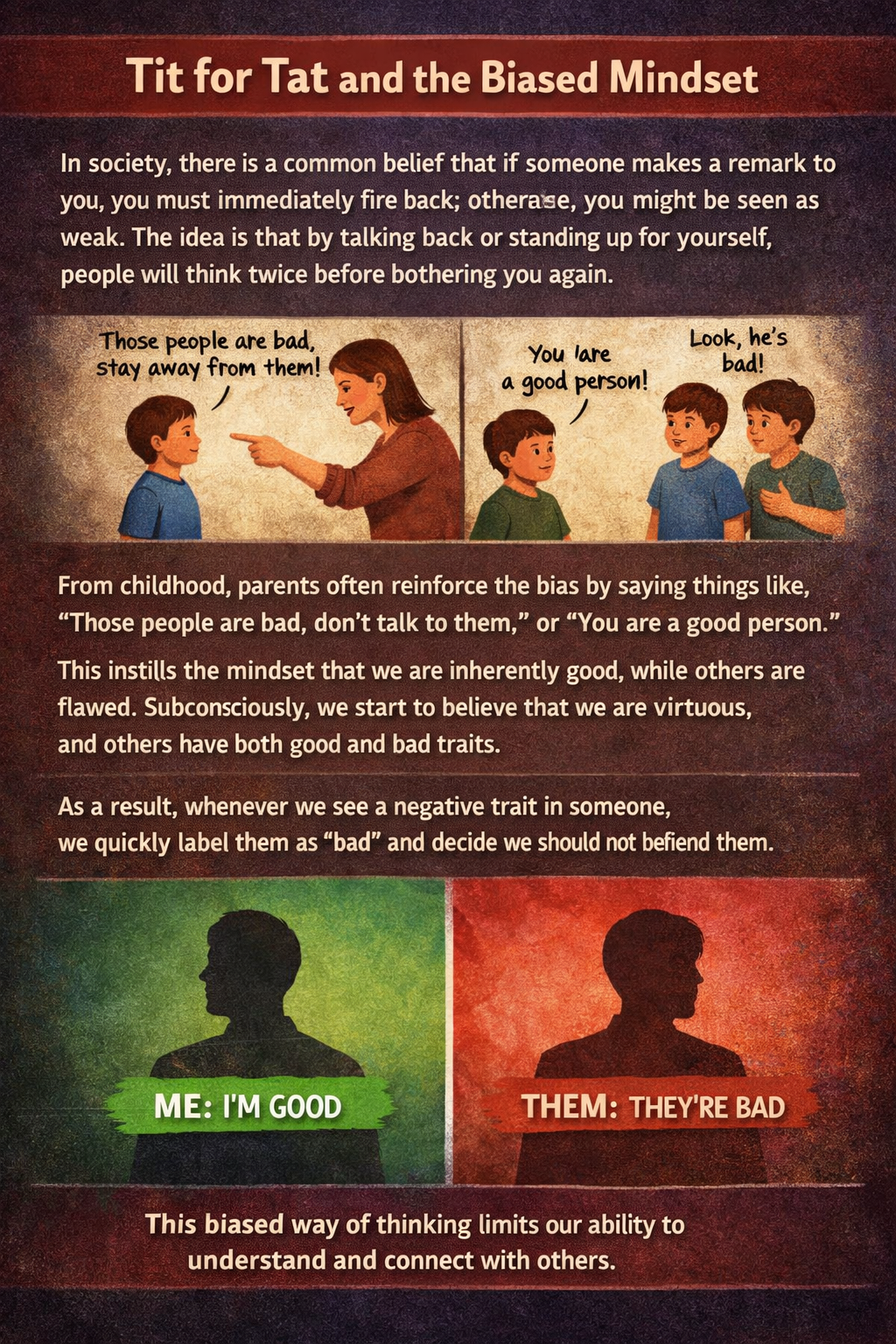
Society often dictates that if someone says something to you, you must retort; otherwise, they might perceive you as weak. The prevailing notion is that if you stand up for yourself and talk back, people will think twice before bothering you again. In essence, the message is that if someone makes a remark, you must fire back at them; otherwise, you will be labelled as weak.
What we need to understand here is this: consciously or subconsciously, almost everyone tends to view themselves as inherently good, while perceiving those around them—be they relatives or friends—as possessing some negative trait.
This stems from a biased mindset. From childhood, parents often reinforce this perspective, saying things like, “Those people are bad; don’t talk to them,” or “These people are bad—focus on your studies instead.” They constantly tell their children, “You are a good person.” Hearing this repeatedly, children begin to internalise the idea that while they themselves are good, others likely harbour both good and bad qualities. Consequently, the moment they spot even the slightest negative trait in someone, they immediately label that person as “bad” and conclude that they should not form a friendship with them.People often find themselves in difficult situations everywhere because they insist on befriending only “good people,” yet fail to perceive goodness in anyone they encounter. When someone says something hurtful, people become confused: what did their parents teach them? Sometimes they were told to speak up in response; other times, they were told to remain silent. Teachers offer similar conflicting advice, as do movies. At times, the adage “delay is poison” is cited; at other times, “patience is paramount.” Unable to discern which principle to follow, people succumb to severe mental stress.
When does the urge to retort—to answer a remark with a remark—arise? It happens when a person feels hurt. The very thought of needing to answer back indicates that they have already been wounded.
However, simply saying “I got hurt” isn’t the whole story; not everyone reacts to the same incident with the same degree of hurt. Whether or not a person feels hurt depends entirely on their individual attitude.
We often assume that if we retort to a comment, the other person will back off and stop saying such things to us. But what actually gets communicated to them is this: “You are hurt by that specific remark.” Consequently, they will repeat that very remark—over and over again. It won’t be just one person doing it; ten different people will do it.
Why do you get angry? It signifies that you are vulnerable in that specific area.
Why, fundamentally, does anger arise within you? It stems from a desire—the expectation that “I am a worthy individual, and therefore, no one should speak to me in this manner.”
For instance, many people—including a young man I know—have told me, “You always look dull; you walk around with a sleepy, listless expression on your face.” Yet, I do not feel any anger. Consequently, the dilemma of whether or not to react simply does not arise for me.
When anger does strike, however, it is nearly impossible to refrain from reacting. Even if you manage to suppress your reaction in that specific moment, that pent-up anger will inevitably manifest itself elsewhere, in some other form or place. Your attitude needs to change. If it doesn’t—and you choose to trade words—you will face one kind of problem. Conversely, if you refrain from reacting but instead bottle it all up inside, you will face a different kind of problem.
Tit for Tat, Tit for Tat ,Tit for Tat


