
Why Has the Need for Psychologists Increased? why need for psychologists is increasing
Psychology is a relatively modern discipline; it originated in the West.
In the past, when people faced mental or emotional difficulties, they would turn to temples, dargahs, or spiritual leaders for guidance.
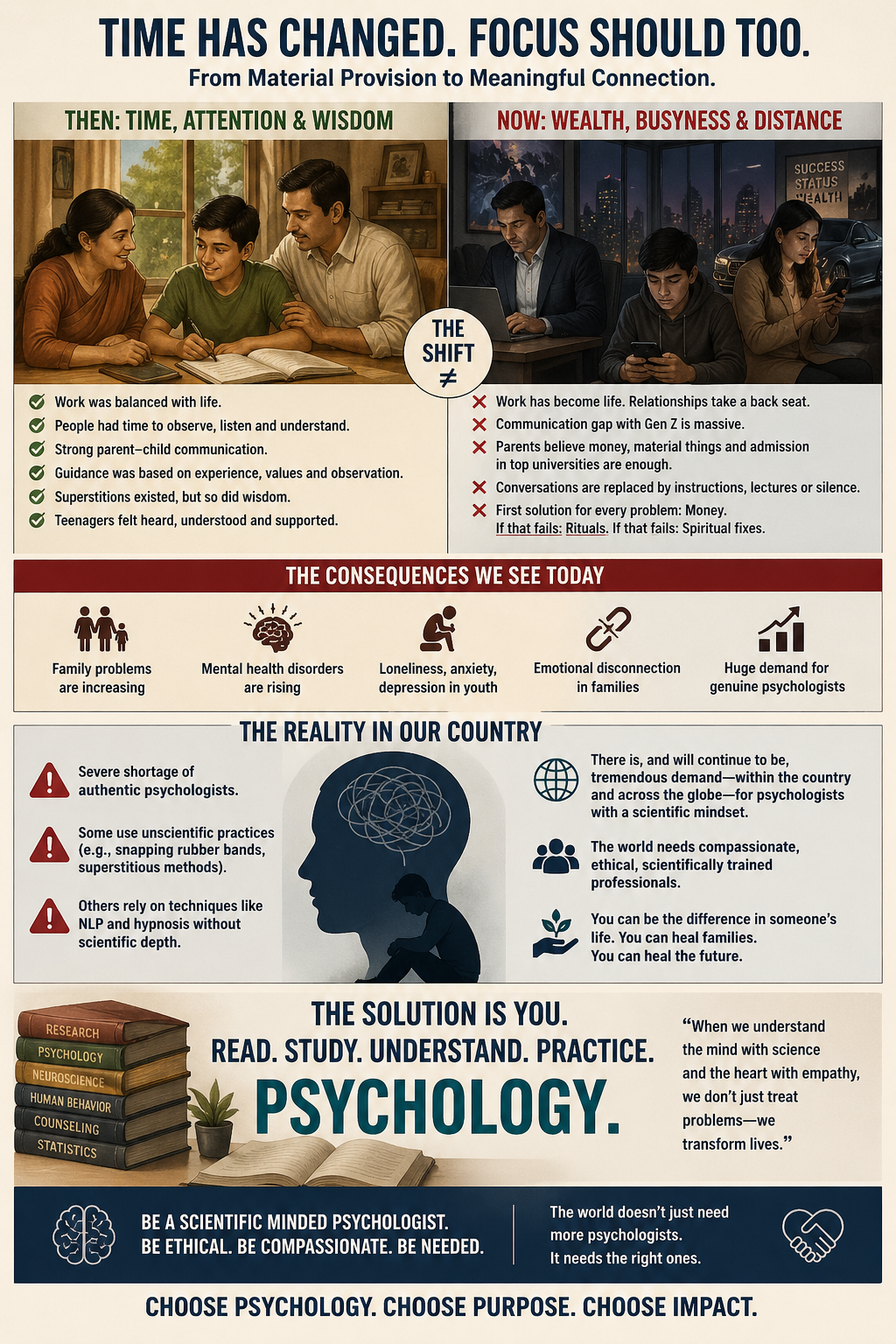
Regarding psychology courses today, the prevailing trend is to simply import syllabi from abroad and apply them here without adaptation. However, the reality in India is that psychology is a culture-centric subject. For instance, the culture in Anantapur (AP) differs significantly from the culture in Adilabad. A psychologist, therefore, needs to possess a deep understanding of these distinct cultural nuances. Instead, many practitioners merely study the subject from an academic perspective and attempt to apply those theoretical frameworks directly in this context. Furthermore, they often propagate concepts unrelated to genuine psychology—often bordering on “pseudoscience”—utilising terms like NLP and hypnosis to market their services under the guise of psychology.
Consequently, the demand for authentic, qualified psychologists has surged dramatically.
Generations X and Y, in particular, placed an intense and singular focus on their careers. When they eventually felt exhausted or overwhelmed, they instinctively turned to spirituality and religion for solace. Ironically, both of these avenues can, in certain contexts, exacerbate rather than alleviate mental health issues.
Because these two generations focused so obsessively on their careers—becoming consumed by the pursuit of wealth—they sought relief from that pressure through spirituality (manifesting as rituals, prayers, and religious observances). This relentless cycle of intense professional pressure followed by a desperate search for spiritual relief ultimately subjected many individuals to extreme stress, causing a significant number of them to succumb to various mental health disorders.In the past, people were not so intensely focused on their careers. They would simply finish their work and return home. Since they had ample free time afterward, they would observe and take note of many aspects of life. While superstitions and unique beliefs certainly existed, there was also a strong element of keen observation. Consequently, they were able to notice the changes occurring during their children’s teenage years and provide them with guidance and education. However, nowadays—having become completely consumed by the pursuit of wealth—parents have created a massive communication gap, particularly with their Gen Z children. Many parents labour under the delusion that they are fulfilling their parenting duties simply because they earn well and provide their children with expensive material possessions.
Furthermore, they often boast about securing management seats in prestigious universities or providing every conceivable opportunity for their children’s education; yet, they rarely speak to them with affection or make an effort to understand what is truly on their minds.
Their primary approach to any issue is to first see if it can be resolved with money. If that fails, they resort to performing rituals or turning to spirituality.
As these two approaches consistently fail, family problems and mental health disorders among people are on the rise. Consequently, there is an immense demand for genuine, qualified psychologists.
In this country, specifically, there is a severe shortage of authentic psychologists. Even among those who do exist, some resort to unscientific practices—such as instructing patients to snap a rubber band on their wrists—or employ methods like NLP and hypnosis.
There is, and will continue to be, a tremendous demand—both within this country and across the globe—for psychologists who possess a scientific mindset. Therefore, read and study psychology.
why need for psychologists is increasing why need for psychologists is increasing


