
All Knowledge Is Ignorance.knowledge and ignorance
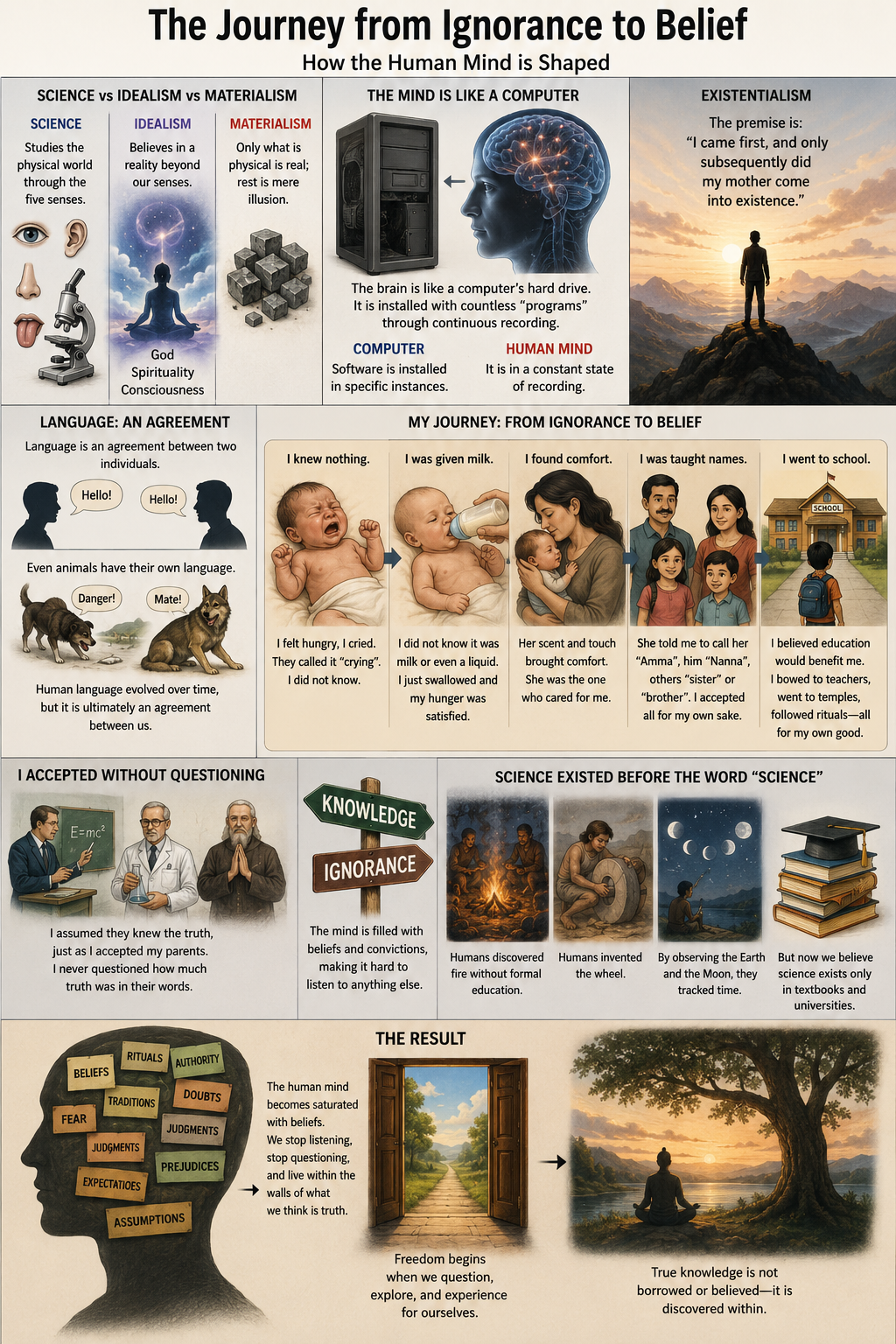
Many people assume that science pertains solely to the physical realm—that is, whatever can be perceived through the five sensory organs. Alternatively, there is the school of idealism, which encompasses concepts such as ‘God’ and ‘spirituality’. This perspective posits that there exists a reality beyond the reach of your sensory organs. Opposing this idealist view are the materialists. The stance of these materialists is to dismiss anything that lacks a physical manifestation as mere idealism.
As for the human mind—our brain functions much like a computer’s operating drive. Inside, we install various “software programs.” Similarly, the constant stream of stimuli to which we are exposed within the environment where we grow up is continuously being recorded. In the case of a computer, software is typically installed in distinct, specific instances; the human mind, however, does not function that way—it is in a perpetual state of recording.
Within the philosophical framework of existentialism, the premise is that “I came first, and only subsequently did my mother come into existence.”Language is an agreement between two individuals. Even animals possess a language of their own; they make one specific sound when danger is present, and a different one when seeking a mate.
knowledge and ignorance knowledge and ignorance
It is often said that human language, too, evolved from one form into another over time. Regardless of how it originated, however, it ultimately functions as an agreement established between us.
When I first emerged from my mother’s womb, I knew nothing of these concepts. I simply felt hungry, and I reacted to that sensation. Those around me labelled that reaction “crying”. I did not know it was called “crying”—I merely reacted; that was all. Then, someone approached and placed something resembling a nipple into my mouth. I did not know she was my mother, nor did I recognise the object as a nipple. I simply gnawed, sucked, and fumbled with it until, eventually, a liquid began to flow. I did not know it was milk, nor did I even recognise it as a liquid—I simply swallowed it. As I swallowed, my hunger was satiated, and I felt a sense of comfort.
Later, that same woman returned and placed that nipple-like object back into my mouth. My vision was still limited at the time, but whenever she appeared, my hunger was relieved. Her scent and her touch brought me comfort. She was the one who cared for me during those early days. She instructed me to call her “Amma” (Mother). Because she provided me with such comfort, I called her “Amma”. I did not truly know whether or not she was my mother; for my own sake—for the sake of that comfort—I simply accepted her as my mother. She then pointed out another person—a man who also looked after both her and me—and told me to call him “Nanna” (Father); so, I called him “Nanna”. She pointed to others and told me to address them as my “sister” or “brother”, and I accepted that as well. The reason for all of this is—ultimately—for my own sake.I went to school believing that doing so would bring me an education. There, I was told that bowing at the feet of a teacher would lead to the acquisition of knowledge. I was also told that visiting a temple and offering prayers would bring about good fortune. I did all these things solely for my own sake.
Subsequently, I began to place my faith in all these practices. I never once questioned them. The reason was that, since I had initially derived some benefit from them, I assumed that whatever they advised was intended entirely for my own well-being. I had no idea how much knowledge they truly possessed; I simply believed them because they spoke with such an air of authority and certainty. Operating under the assumption that they genuinely knew the truth—much in the same way I accepted my mother and father without question—I accepted these universities, scientists, and everyone else. Yet, I remain unaware of how much truth actually lies within their claims.
The concept of “science” existed long before the word itself was coined. Nature has always functioned in this precise manner. Humans discovered fire at a time when they possessed no formal education—indeed, our modern systems of learning did not even exist back then. Humans invented the wheel. By observing the rotation of the Earth, they were able to calculate and track the cycles of the New Moon and the Full Moon. However, we have now shifted our perspective; from the moment we began to believe that “science” resides exclusively within university classrooms and textbooks, we have become unwilling to listen to anything that anyone else has to say. This is because the human mind has become thoroughly saturated with a multitude of beliefs and convictions.
knowledge and ignorance knowledge and ignorance


