
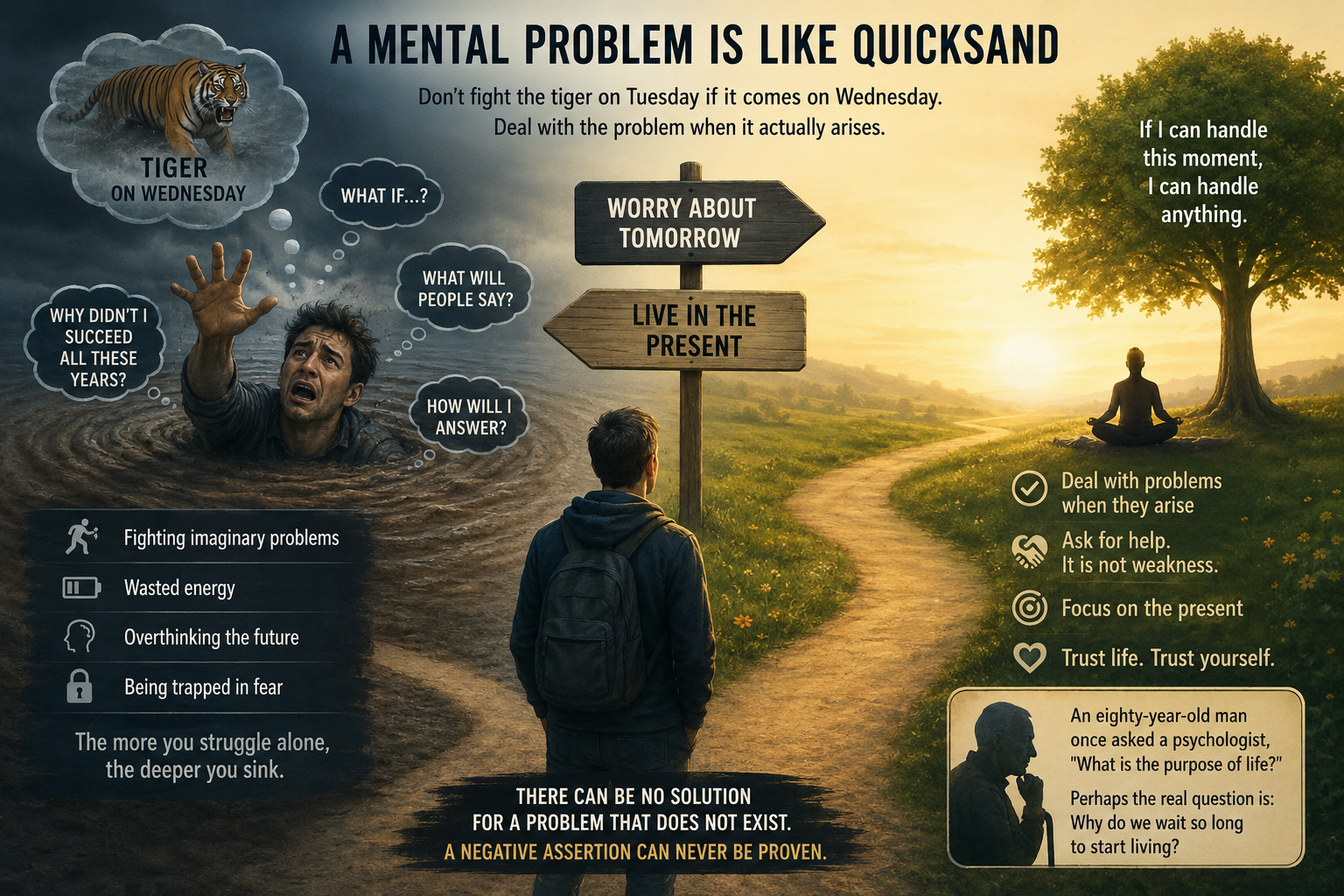
How to get rid of mental illness. A Mental Problem Is Quicksand A “mental problem” implies that we are seeking a solution to a problem that does not actually exist. Imagine a tiger is scheduled to arrive on Wednesday; yet, on Tuesday, we are already fighting it off. All our energy is wasted. We become drained, and no tangible result is achieved. We get stuck in that quicksand. The core issue is that we are searching for a solution to a non-existent problem. So, what is the remedy for this? Let us deal with the problem only when it actually arises. Even if it looms large in our minds—making us doubt our ability to face it—we will inevitably find a way to confront it when the moment actually arrives. Consider a person who suffered from anxiety but eventually overcame it through counseling. He struggled with this mental issue for many years. Now that he has emerged from it, he has achieved success in his profession. However, he is terrified that his relatives will ask him, “Why didn’t you achieve success all this time?” Society—or rather, the people around us—rarely ask such questions; they almost never ask, “What have you actually accomplished so far?”—especially not when you have finally achieved success. The real issue here is not whether his relatives will actually ask the question or not; rather, he is preemptively assuming they will ask and is preparing himself for that scenario. By constantly agonizing over how to answer if someone were to ask, he finds himself trapped even deeper within this mental loop.A mental health issue is akin to quicksand. Once you become trapped in it, external assistance is essential. Asking for help is not a sign of weakness. Indeed, asking is not the weakness; rather, the refusal to ask is the true weakness.
There can be no solution for a problem that does not exist. A negative assertion can never be proven.
If I know how to handle this present moment, I can handle anything. What we are essentially doing is preparing for the next moment while neglecting the present one. Preoccupied with thoughts of how tomorrow might unfold, we are unable to fully engage with what we are doing today. We find ourselves constantly contemplating—”How will tomorrow be?” followed by, “And what comes after that?” Our entire lives unfold in this manner; we spend our days perpetually wondering how we will manage tomorrow. This remains true, even if one lives to be a hundred years old.
An eighty-year-old man once asked a psychologist: “What is the purpose of this life?” At that stage, one might ask: “What is the point of seeking to discover that purpose now?”
How to get rid of mental illness.
How to get rid of mental illness. How to get rid of mental illness.


