
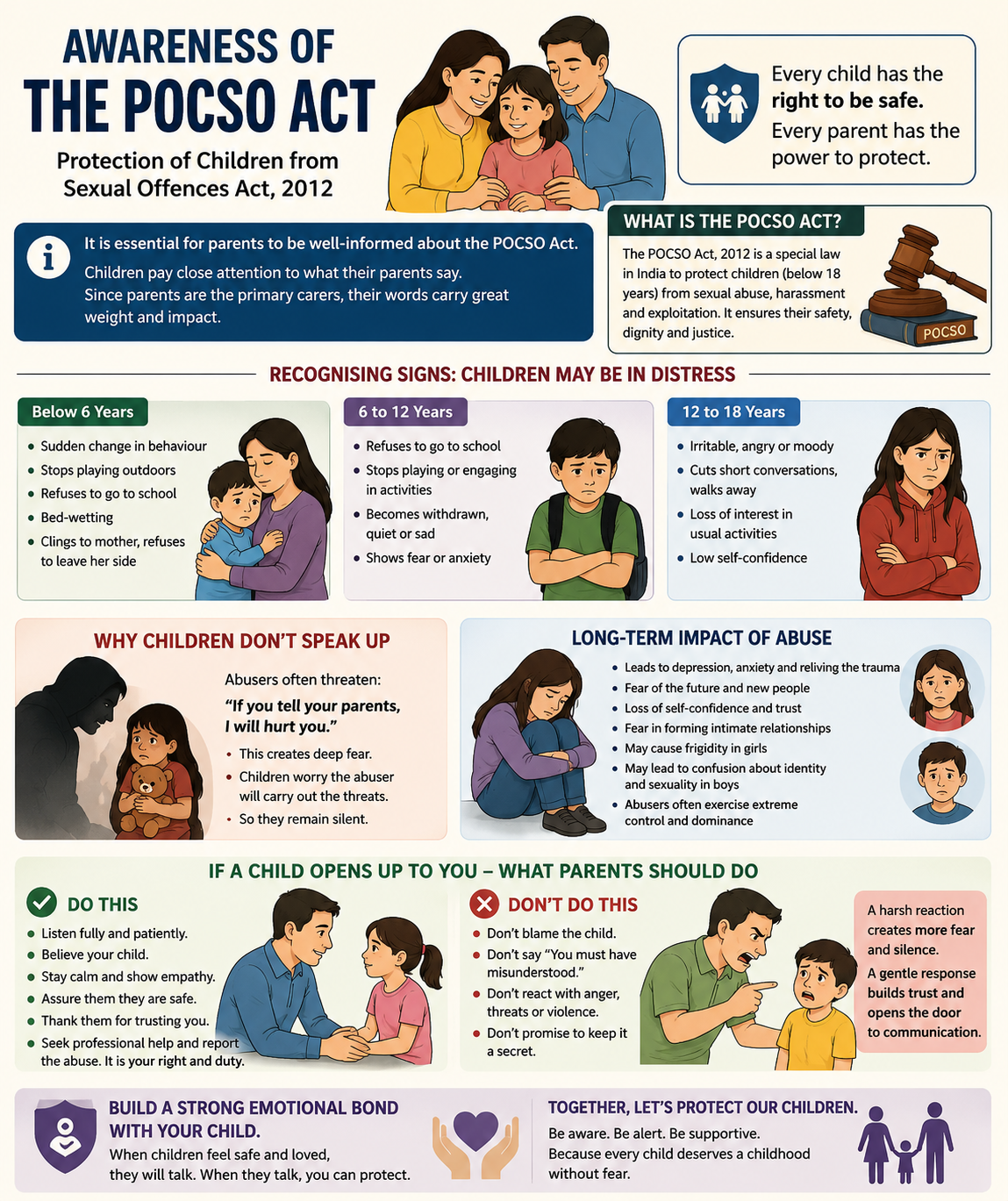
It is essential for parents to be well-informed about this act. This is because children pay close attention to what their parents say. Since parents serve as the primary carers for their children, their words carry significant weight and are communicated with great impact.
If children are subjected to abuse, it is crucial for parents to recognize the signs. Such situations often manifest as a sudden change in the child’s demeanour. Specifically, a child’s established “normal behavior” undergoes an abrupt shift; they may suddenly cease engaging in activities they previously enjoyed. At this juncture, parents must be observant and recognise that the child is not behaving as usual—that something within them has changed.When such incidents occur in young children, a common consequence is that those who previously enjoyed playing outdoors suddenly stop doing so. They may refuse to go to school. In very young children—specifically those under the age of six—such experiences often manifest as bed-wetting or clinging incessantly to their mothers, refusing to leave their side. They behave this way because they feel a sense of security only when they are with their mother. The manifestation of these effects varies across different age groups. When incidents occur in children between the ages of six and twelve, they typically refuse to attend school and cease playing altogether. During such times, parents must recognize that their children are in distress. It is essential to strengthen the emotional bond with them; if a strong bond exists, the children are more likely to open up and confide in their parents about any issues they are facing. In the case of adolescents aged 12 to 18, there is a greater likelihood that they will speak up and open up about their experiences. However, their behaviour may still undergo certain changes, such as becoming irritable, displaying anger, or abruptly cutting short conversations and walking away while speaking with others.In some cases, abusers instill deep fear by threatening victims: “If you tell your parents, I won’t let you off the hook; I will hurt you.” Consequently, the victims become terrified. Naturally, they fear that the abuser might indeed carry out these threats or inflict further harm; for this very reason, they are unable to open up or speak out.
For individuals who have suffered abuse during childhood, the incident often triggers a psychological response—specifically, the onset of depression. They frequently relive the memory of the trauma, experiencing lingering emotional pain. Furthermore, their anxiety regarding the future intensifies significantly. They become deeply apprehensive, worrying about how strangers might treat them when they encounter new people in the future. Having previously placed their trust in someone only to suffer such harm, they are left with a lingering doubt: “Can I truly trust new people going forward?” They struggle to maintain their self-confidence, as the trauma of that past incident continues to weigh heavily upon them. Consequently, they harbour immense fear when it comes to forming intimate relationships with others. Among girls, this trauma can lead to the development of frigidity; among boys, it may result in them identifying as gay. In the case of boys, the abusers—those who perpetrated the abuse—often exert extreme control and dominance over their victims.
If children approach their parents to share a concern or issue, the parents’ primary responsibility is to listen to their child’s account fully and without interruption. Parents must avoid dismissive responses such as “You must have misunderstood the situation; things couldn’t have happened that way.”
A gentle and empathetic approach is all that is required. When parents adopt such an approach, the fear within the children dissipates, and they feel empowered to open up and communicate freely with their parents. Conversely, if one immediately reacts by loudly arguing—threatening to hit or verbally abuse the perpetrator—the children become terrified. Since they have already witnessed a frighteningly intense reaction once, the children stop speaking up; they fear that if they were to mention it again, the reaction might be even worse.
Awareness of the POCSO Act Awareness of the POCSO Act Awareness of the POCSO Act


