
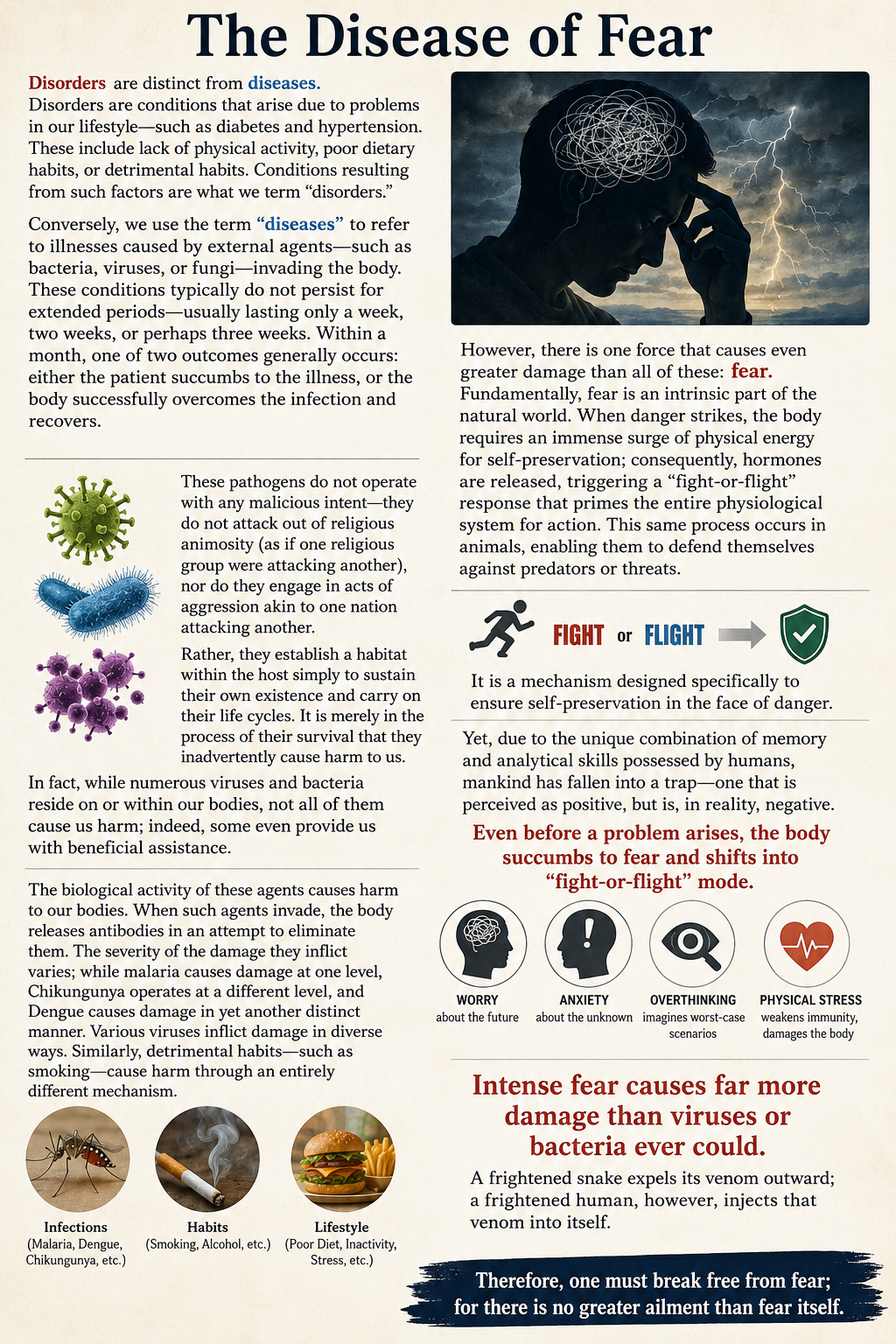
The Disease of Fear How Fear Affects Daily Life
Disorders are distinct from diseases. Disorders are conditions that arise due to problems in our lifestyle—specifically, issues such as diabetes and hypertension. These lifestyle-related difficulties include a lack of physical activity, poor dietary habits, or the presence of detrimental habits; conditions resulting from such factors are what we term “disorders.” Conversely, we use the term “diseases” to refer to illnesses caused by external agents—such as bacteria, viruses, or fungi—invading the body. These conditions typically do not persist for extended periods—usually lasting only a week, two weeks, or perhaps three weeks. Within a month, one of two outcomes generally occurs: either the patient succumbs to the illness, or the body successfully overcomes the infection and recovers.
How Fear Affects Daily Life How Fear Affects Daily Life
These pathogens do not operate with any malicious intent—they do not attack out of religious animosity (as if one religious group were attacking another), nor do they engage in acts of aggression akin to one nation attacking another. Rather, they establish a habitat within the host simply to sustain their own existence and carry on their life cycles. It is merely in the process of their survival that they inadvertently cause harm to us. In fact, while numerous viruses and bacteria reside on or within our bodies, not all of them cause us harm; indeed, some even provide us with beneficial assistance.The biological activity of these agents causes harm to our bodies. When such agents invade, the body releases antibodies in an attempt to eliminate them. The severity of the damage they inflict varies; while malaria causes damage at one level, Chikungunya operates at a different level, and Dengue causes damage in yet another distinct manner. Various viruses inflict damage in diverse ways. Similarly, detrimental habits—such as smoking—cause harm through an entirely different mechanism.
However, there is one force that causes even greater damage than all of these: fear. Fundamentally, fear is an intrinsic part of the natural world. When danger strikes, the body requires an immense surge of physical energy for self-preservation; consequently, hormones are released, triggering a “fight-or-flight” response that primes the entire physiological system for action. This same process occurs in animals, enabling them to defend themselves against predators or threats.
It is a mechanism designed specifically to ensure self-preservation in the face of danger.
Yet, due to the unique combination of memory and analytical skills possessed by humans, mankind has fallen into a trap—one that is perceived as positive, but is, in reality, negative.Even before a problem arises, the body succumbs to fear and shifts into “fight-or-flight” mode.
Intense fear causes far more damage than viruses or bacteria ever could.
A frightened snake expels its venom outward; a frightened human, however, injects that venom into itself.
Therefore, one must break free from fear; for there is no greater ailment than fear itself.
How Fear Affects Daily Life How Fear Affects Daily Life


